
From 1634 to February 1637, by popular accounts, the Dutch Republic was widely in the grip of Tulip Mania. Tulip bulbs reached a point by December 1636 where they were trading at more than ten times their 1634 price a single bulb. One particular strain of tulip, known as the Viceroy, traded at a value of 238K for a single bulb. It was the first major speculative asset bubble in recorded Western history. Popular lore, mainly spread by 19th-century historian Charles Mackay for Tulip Mania, was that it was widespread and that the Dutch working class was all-in on the opportunity to get rich quickly. In her 2007 study, Tulipmania, Anne Goldgar said “It might not have been a financial crisis, but it was a social and cultural one. In tulipmania, Dutch burghers confronted a series of issues that in any case gripped their culture: novelty, the exotic, capitalism, immigration, the growth of urban societies, and all the problems and excitement such issues raised. People in the 1630s and after found tulipmania a wonder, something to be marveled at, like a fireball, a child with two heads, or a plague of mice. But they also found it to be a warning. That warning, and the images it raised in the minds of those calling our attention to it, has always been treated as if it were a mere fact. Yet the reasons for the warning have scarcely been explored.”
The ignored reasons for Tulip Mania included growing wealth inequality, the Dutch guilder facing rampant inflation, and a nation licking its wounds from a bout of Bubonic Plague that killed 10% of the population just a few years before. It’s hard to look at the conditions that lead to Tulip Mania and not see them replicated in the current United States, especially when considering the rampant speculation by a small percentage of the population in cryptocurrency. It’s likely why director Cutter Hodierne and writer John Hibey named the crypto exchange in their new thriller COLD WALLET after tulips. It’s a movie that understands that even as we navigate a vicious, hyper-futurist world, that we’ve done this before. Whether it’s tulip bulbs, stock in the South Sea Company, or Beanie Babies, the madness of crowds will drive investment in the ephemeral and foolish, despite evidence that it is a bubble.

Cryptocurrency adds the dimension that now bubbles can be artificially manipulated and created and don’t simply collapse when the scales fall from the eyes of the people. They collapse when manipulators dump their poisonous holdings, leaving their acolytes hopelessly fucked. “Hawk Tuah Girl makes millions in pump-and-dump meme coin scheme” is a sentence that defies understanding of language. The tulips no longer exist.
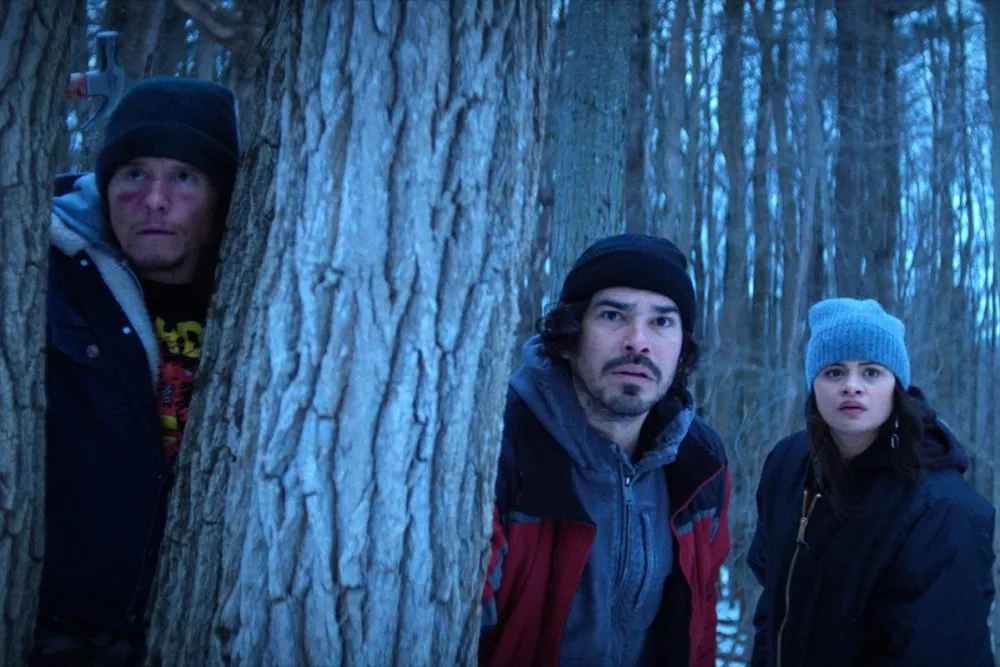
COLD WALLET tries to solve an interesting puzzle. How do you execute a bottleneck heist thriller when the thing the thieves want to steal doesn’t even really exist? Raul Castillo is Billy, a man radiating peak ‘divorced-dad’ energy. He wants to provide for his daughter, but most paths to financial solvency seem impossible, and he’s thrown what little money he has into Tulip ETX, as has his friend Dom, played by Tony Cavalero. When word that exchange owner Charles Hegel (Josh Brener) has died, their accounts are frozen, and in Dom’s case, now there’s a notice that they owe money to the exchange. Seemingly their last possible bet has turned poisonous. Billy is messaged on a crypto subreddit by Eva (Melonie Diaz), who says she has evidence that Hegel has faked his death and that she is holed up relatively close to them. She proposes a heist for Hegel’s “cold wallet,” which are physically maintained key sequences that will allow access to Hegel’s Ethereum, which can be converted to US Dollars, a made-up currency that everyone agrees is “real.” So the three of them embark on a mission which they hope will be a little light breaking-and-entering and tell themselves that at worst, it will be a little roughing one guy up, and then they will be on their way.
The thing that propels COLD WALLET is that, collectively, we value capital more than our own lives. It’s a sickness. When the group breaks in, they find Hegel, alive, and he’s unwilling to provide the cold wallet or the needed key phrases that give it value. Even when confronted with guns waved in his face and the possibility of arrest, it’s more important to him to hoard his wealth. It immediately reminded me of the way PANIC ROOM used a heist to explore class, race, and gender dynamics. In that film, Jared Leto’s character is already wealthy and seeks to amass more wealth. He doesn’t consider the danger to the new homeowner or how personal the stakes are for Forrest Whittaker’s character, who was also radiating ‘divorced-dad’ energy.
By shifting the dangerous hoarder of wealth from one of the perpetrators to the “victim” in COLD WALLET, it makes the class divisions more clearly defined and easier to invest in this heist. Brener repulsively slithers as Hegel. Any time his character is alone with one member of the heist crew, he tries to buy his own safety by pitting them against each other. He plays to their priorities and vanities like a dragon offering gold to each rogue if they’ll only slit the throat of their fellow thieves.
Brener’s performance of slippery manipulation would fall flat if his costars in this four-hander came up short. Thankfully, that’s anything but the case. Raul Castillo’s Billy doesn’t just have ‘divorced-dad’ energy, his character literally is one. He plays it with a combination of exhibited care towards his daughter and barely-checked rage towards Hegel that gives the character a sympathetic, childlike quality. He earnestly believes he’ll be able to spin Ethereum into a home for himself and his daughter, and the audience’s reaction isn’t to scold him for his naivety, but an empathy that comes from how sad it is that this man thinks he’s found the last fair system that allows people to dream and that it’s beenstripped away.
Tony Cavalero has been turning heads for years on The Righteous Gemstones as Keefe, a deeply loyal ex-Satanist who radiates queer affection towards Adam DeVine’s Kelvin Gemstone. In COLD WALLET, Cavalero plays a character that feels like he could have stepped out of a late-era Adam McKay morality play about capitalism (one of the good ones). Unlike his fellow heist participants, the news about the collapse of Tulip ETX seems even worse for Dom. Why? Like so many real-world folks pursuing crypto wealth, he does so against extended credit. When Tulip freezes, he suddenly finds himself on the hook for close to $70K. We find out that he’s taken an ownership stake in a martial arts studio because of how bullish Billy is on the crypto, and his business is suddenly in danger and he owes money he doesn’t have. COLD WALLET mines this for friction and laughs by having Dom live his life with a bullshit, affected inner peace. Cavalero is able to vacillate between scary and funny as needed.
Melonie Diaz’s character, Eva, is the moral accelerant of the narrative. While Billy and Dom have a child and debt respectively to worry about, she pushes both of them into participating from a place of moral clarity. She wants to get access to the cold wallet and then perform an airdrop to make wronged Tulip ETX users whole again. She’s got more in common with an early 20th-century outlaw folk hero or Robin Hood than most characters associated with heist imagery. Danny Ocean never had the force of righteousness on his side. Diaz gives the role a sense of charisma and authority. It’s apparent why the other two are willing to saunter into a Wal-Mart to buy weapons with her.
It’s worth calling out the editing and blocking here. Framed never feels clumsily composed here and characters are positioned in ways that reinforce the power dynamic in the moment. A slow push on a close-up or cutting to a wide can remind us who all of these people are to one another. Importantly, the editing is patient. Since so much of the film hinges on the stress of the heist and Hegel’s efforts to fuck with the heist crew, long lingering shots as we watch their faces make a circuit of emotion are invaluable.
Without venturing into spoiler territory, the third act keeps a steady hand on the themes presented and will satisfy fans of hopeless heists and critics of the modern crypto landscape. There’s an emergent whaling motif, which makes the audience reckon with the idea that wealthy, monied villains view the market, people, as a single whale to be killed. If the name of exchange was meant to intentionally conjure Tulip Mania, then Hegel’s viciousness and never operating honestly with the exchange will make the audience think of Sam Bankman-Fried or Elizabeth Holmes.
Some might see Steven Soderbergh’s producer credit and hope for a light and breezy, sexy heist, like OUT OF SIGHT or OCEAN’S ELEVEN. But for nearly as long as Soderbergh has been making movies, he’s found time and room to focus on the predatory behavior of the super-rich and the systems that protect them. So if you were going in expecting a vibe, think less ‘fun Vegas heist’ and more CONTAGION, THE LAUNDROMAT, and NO SUDDEN MOVE. It’s what you might call a good “feel-bad” time and it’s one I highly recommend.


them, not even once. When he’s not disappointing his cats he’s watching and writing about film.
His interests run toward naturalism, SOV and forgotten thrillers. Against his better judgment he
has hosted a podcast, Impossible Coin, for six years.
Tags: Andrew Silagy, Brian Cartwright, Crime, Cutter Hodierne, History, John Hibey, Josh Brener, Maciej Zieli?ski, Melonie Diaz, Oliver Millar, Patrick Taylor, Raúl Castillo, Steven Soderbergh, Thriller, Tony Cavalero, Vanishing Angle, well go usa, Zoe Winters
No Comments