
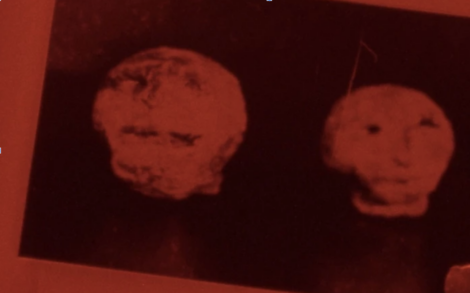
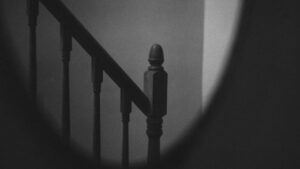
“Time, as it were, is trapped and can’t move on…the family home seemed to have been violently altered by the presence of the stones.”
Mattijs Driesen and Chloë Delanghe’s 34-minute experimental folk horror short (mixed VHS scans/still photography) HEXHAM HEADS is a hauntological dark night of the soul and a personal standout from Unnamed Footage Festival Vol. 8. Like SKINAMARINK, HEXHAM HEADS insists upon its own (at first) inscrutable grammar, almost impossibly alienating us from the familiar architecture of the most commonplace domestic spaces. This is not a film everyone will have patience for, but it’s the right kind of slow drip dread for me.
Delanghe and Driesen have created an uncanny assemblage of architectural horror from the most ordinary landscapes and places – a nondescript house, a street, a darkroom, a building supply warehouse. Delanghe’s grainy, lo-fi photography exposes the numinous possibilities shivering beneath the surface of everyday objects. Every chestnut door frame, every Bannister railing is imbued with an eerie presence that borders on agency. Time itself is wrong somehow, warped, but not in ways the genre has yet equipped us to understand – time and place are stretched, frozen, looped, quivering. Sometimes it’s hard to tell if things are still or rippling in the dark; you second guess yourself. As our narrator says, quoting H. Russell Wakefield’s “A Black Solitude,”
Such places as these are as rare as they are perilous. In a sense this is a timeless place. What once happened here didn’t change, didn’t pass on, it was crystallized. What happened herein eternally repeats itself.
There’s an uneasy disconnect between what’s described in Delanghe’s mellifluous narrative voiceover and the minimalist fits and starts of images that appear on screen. While the narrative lasts, it traces a spectral, meandering path around the visual – sometimes aligning, often diverging, projecting a second mental movie into viewers’ heads to play alongside the one you can actually see. This tense audiovisual interplay is reminiscent of John Smith’s avant-garde short film THE BLACK TOWER (1987), to which HEXHAM HEADS’ formal structure and still photography manipulation techniques perhaps owe a debt.
Watching the short, I felt myself becoming unmoored in real time, at times lulled nearly to sleep by the licks of time-lapsed artificial flames and cool stream of Delanghe’s voice, at times impatient as my vision filled with greater opacities of red, and frequently rapt with fear as doorways and stairwells seemed to breathe down the back of my neck, woodwinds and strings pumping like blood in my ears, ripping my nervous system to shreds.
From her darkroom, our narrator explores the intertwined mysteries of photosensitivity and “stone tape theory” (from Nigel Kneale’s 1972 BBC film THE STONE TAPE), which speculates that minerals in rocks can record and replay the energy of hauntings.
“It makes me think that as long as we are living in houses made of stone, we are somehow always surrounded by these recordings.”
In a satisfying twist for a film at a found footage festival, lost audio has recently been recovered of a now infamous 1976 BBC current affairs report on the titular Hexham Heads incident. This broadcast aired only once but apparently left quite an impression on its viewers, and the clip has become infamous among paranormal enthusiasts.
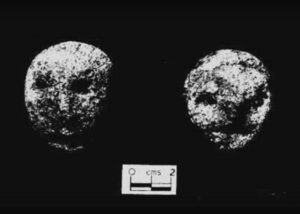
In 1971, two young boys discovered two strange stones with carved faces while digging in their backyard in northern England (not far from Hadrian’s Wall). Their family reported strange happenings inside their home upon taking the stones inside, including the apparition of something like a weresheep (surely unrelated to an anecdotal report of a drunken prank with a sheep carcass stolen from the nearby slaughterhouse, as mentioned in this excellent background piece on the heads). The stone heads seemed to bring supernatural misfortune to all who harbored them, circulating briefly between investigators before coming to Celtic scholar and archaeologist Anne Ross. Ross, a sometimes historical expert presenter on the BBC, was convinced of their ancient origin, which happened to coincide with her research focus on the Celtic “cult of the head.” In the clip, Ross claims that she and her family have experienced disturbing sightings of a werewolf-like creature in their home.
Despite Ross’s insistence on the heads’ Celtic antiquity, the previous owner of the house where they were first found insisted that he had sculpted the heads himself out of rock and cement, burying them in the garden to amuse his grandchildren back in the 1950s. But by then it was too late. The heads had already entered the realm of hyperstition, their mythologization taking on a life of its own. If not the echoes of ancient Celtic decapitation rituals, the stones had absorbed the reputation as “ancient” cursed objects that was projected onto them. The whereabouts of the heads is currently unknown.
What do stones remember? Can we be haunted by something that never happened?


Tags: A Black Solitude, Anne Ross, Chloe Delanghe, Film Festivals, H. Russell Wakefield, Hexham Heads, John Smith, Mattijs Driesen, Nigel Kneale, The Black Tower, The Stone Tape, Unnamed Footage Festival, Unnamed Footage Festival Vol 8, Violet Burns
No Comments