
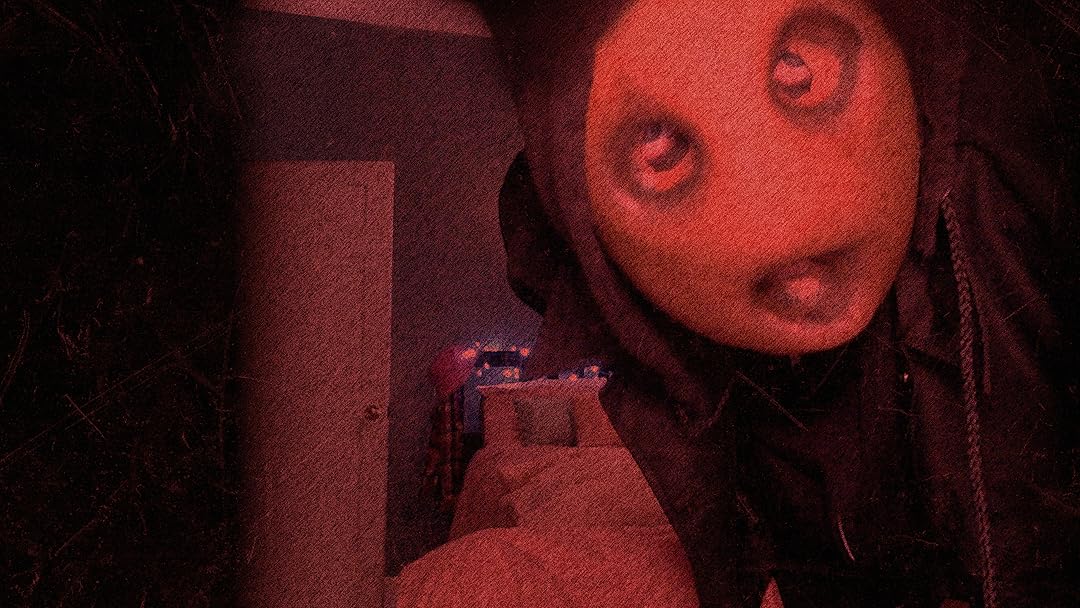
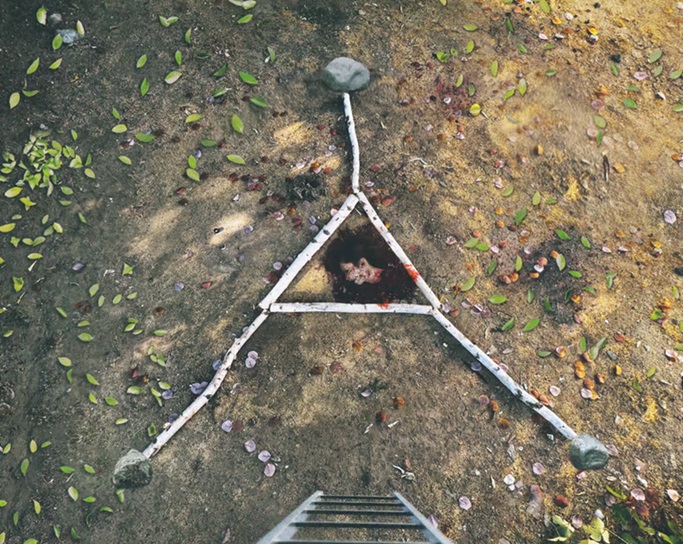
Under the family’s dining room table are three buckets of blood labelled like measuring cups: “Going. Going. Gone.” A cryptic triangle marked by three distinct points has been painted in blood on the ceiling above them.

I didn’t realize how badly STRANGE HARVEST had shaken me until I had to wind through the near-empty parking garage alone at midnight – car key tucked between white knuckles, resisting the irrational urge to look over my shoulder. I was rattled, and I wasn’t quite sure why. As a desensitized tar pit with mean taste, I sometimes bemoan the depths of my tolerance. It’s hard for a film to unsettle me these days, and there I was checking the back seat of my car with my flashlight (more than once). What time-released spell did Stuart Ortiz (half of the duo that brought us indie found footage classic GRAVE ENCOUNTERS) cast on me with his first solo feature?
STRANGE HARVEST is set in the Inland Empire of Southern California, and perhaps the familiarity of the wide, serpentine highways and beige stucco strips dotted with half-dead palms felt a little too close to home. As bodies pile up over the course of nearly two decades, dots connect towards Mr. Shiny, a sadistic, ritualistic serial killer whose victim choices seem to follow no externally discernible pattern.
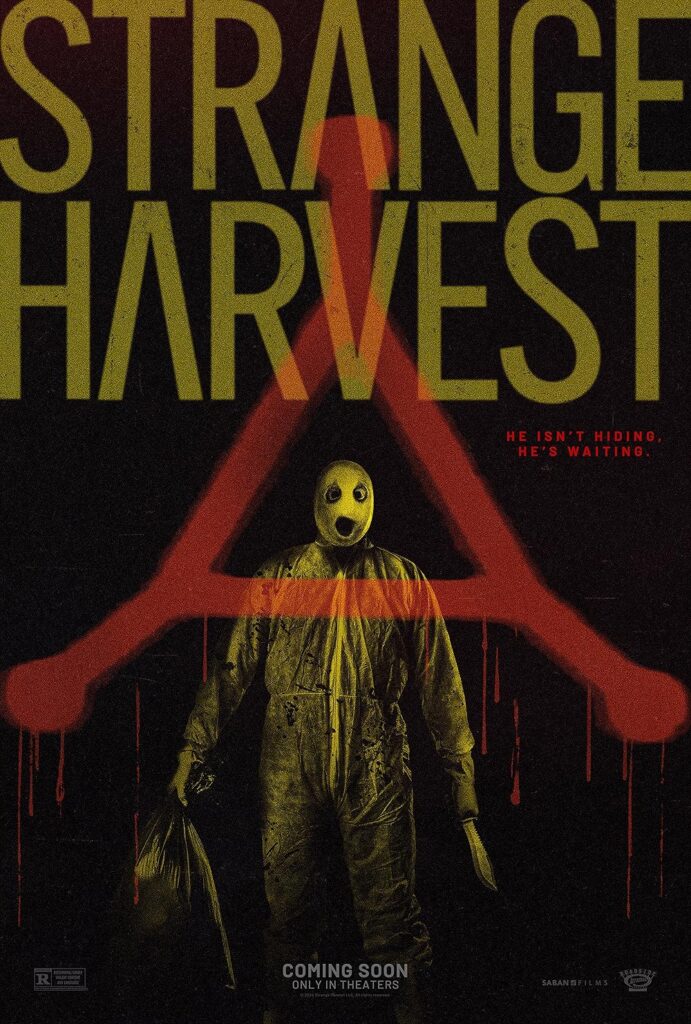
STRANGE HARVEST is a slick, immersive “true crime” faux doc that makes excellent use of the genre form – perhaps too good for some who may want a more high-octane horror-thriller pace. It does for grisly serial killer streaming docs what HORROR IN THE HIGH DESERT did so effectively with Dateline.
Particularly in its first half, STRANGE HARVEST often feels like something Netflix could have pumped out in 2021, and I mean that as a sincere compliment as an appreciator of the art of imitation. The film flits between a variety of extremely convincingly-rendered fictional “sources”— extravagantly gruesome, sticky crime-scene imagery (which we are not spared by blurring), interviews, bodycam footage, local news reports, CCTV recordings, and eventually chilling footage of Mr. Shiny at work. It’s a gnarly patchwork of wickedly convincing pseudo-reality that keeps you guessing at every turn.
The film’s staggering realism (thanks no doubt to Seth Fuller’s clever, agile cinematography) and smart editing choices by Ortiz make the sick violence hit so much harder. Mr. Shiny’s strangely clinical bloodlust is not constrained by location or type, which perhaps explains my mounting paranoia as I wound through the stucco box of the theater’s parking garage. Mr. Shiny’s methods vary widely, but he is consistently a meticulous extractor and arranger of blood and flesh. He speaks in riddles a la Zodiac, taunting the police and hinting at strange supernatural logics. We learn he is a true believer, but in what?
True to genre form, the film’s narrative is anchored by well-executed talking head interviews with candid law enforcement officers Joe Kirby (musician and actor Peter Zizzo) and Alexis Taylor (Terri Apple), who wish they knew then what they know now. What one may perceive as the film’s mild flaws feel to me like sleight of hand. The docu-streaming form is sometimes repetitive and overly directive by design (as is the hallmark of content for viewers wanting to half-absorb schadenfreude while washing dishes), and Ortiz’s faithfulness to this convention helps repeatedly lull viewers into a false sense of security before plunging them back into the shock of cold blood.
It’s best to go into this film blind and let the mystery unfold before you. Watch it alone in the dark. Keep looking over your shoulder. Watch the skies.


Tags: Andy Lauer, Horror, Matthew Peschio, Mockumentary, Peter Zizzo, Roadside Attractions, Saban Films, Sarah Decourcy, Seth Fulleer, Stuart Ortiz, Terri Apple, The Vicious Brothers, Violet Burns
No Comments