

When I was 22 years old, I took a job at a 24-hour copy shop to work third shift, four nights a week. Monday through Thursday, my workday would start at 10pm, and run until 7:30am. The copy shop was about a mile from my home, and I’d walk there each night, watching the world wind down. It was situated in a shopping center, and sitting kitty-corner to the copy shop was a grocery store. On my way to work each night, I’d stop and talk briefly to Stavros. He was sweeping the front of the grocery store before its close for overnight stocking at 11pm. We didn’t really have much in common except the night, but for the next three years, that quick nightly chat with Stavros would be some of my most consistent human contact.
The copy shop was nestled on the edge of a large, old, respected public university with a teaching hospital. The school is what folks would call a “public Ivy.” The buildings were a mixture of neoclassical homages to the school’s 18th-century origins and liminal asymmetrical postmodern monstrosities. Honestly though, what all the buildings looked like didn’t matter as much as the fact they were empty. The copy shop’s business was driven by the university. We had enough to keep us busy 24 hours a day, but foot traffic at 3am was really only confined to finals season in the fall and spring. The rest of the year, the world felt empty. I was a ghost that haunted my own world.
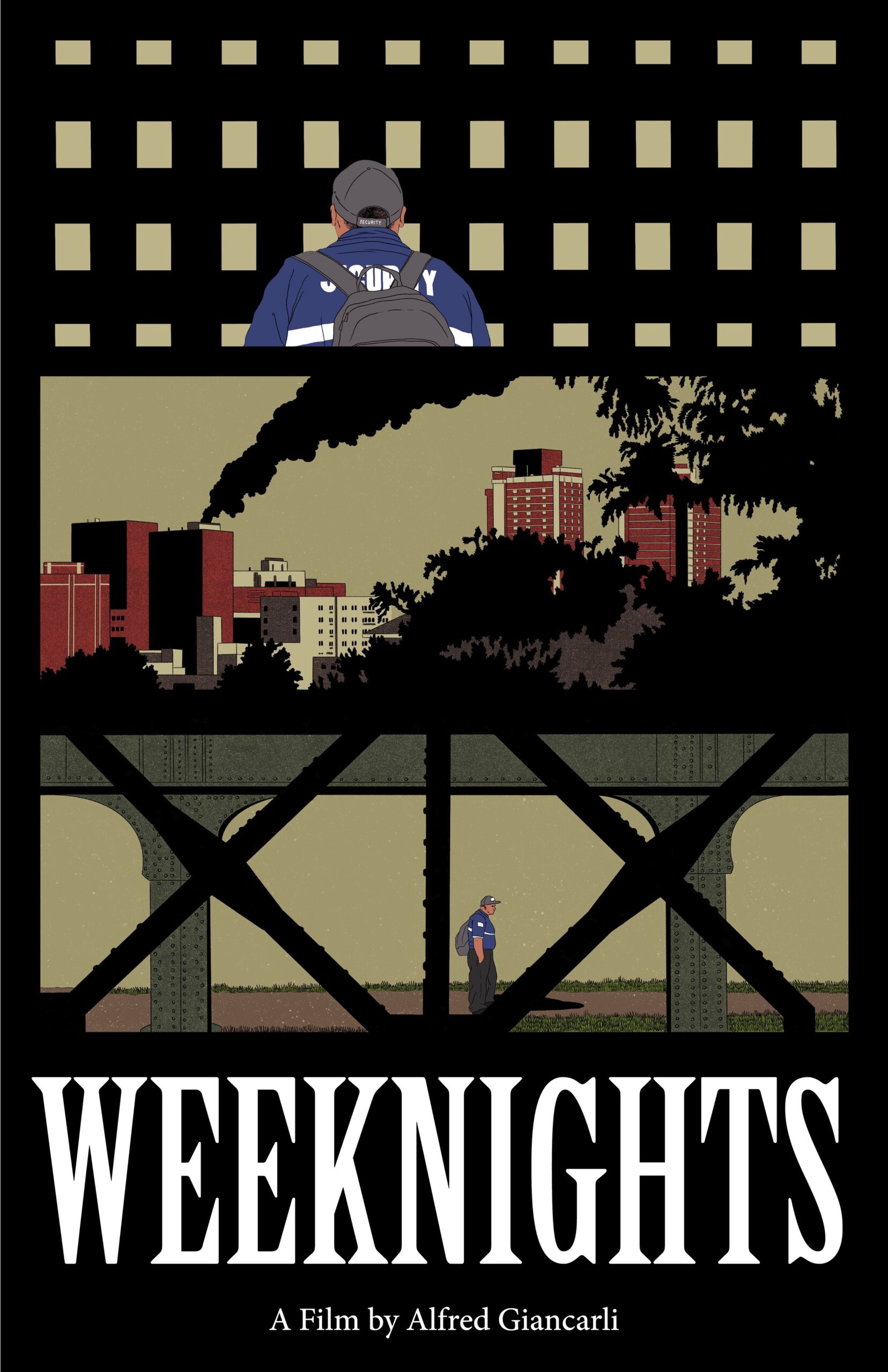
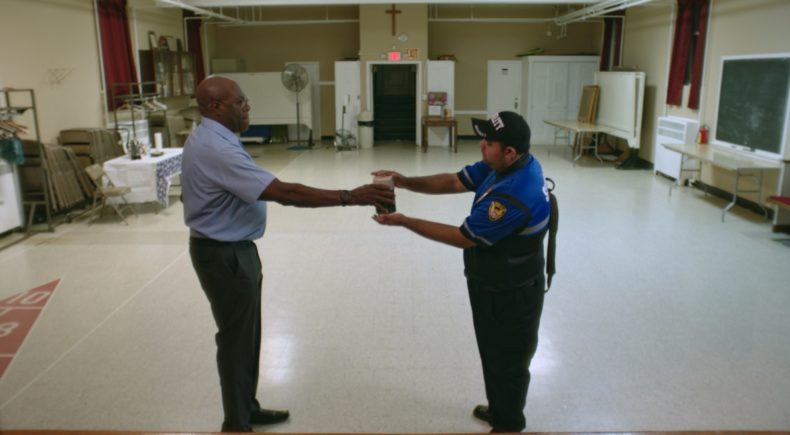
Alfred Giancarli’s WEEKNIGHTS is one of a handful of movies that captures the dimensionality of the lonely night for the solitary worker. The film primarily follows a solitary security guard, played by Julian Velez, through a single night of his work. When we find him, we see he is in a room before work, with a circle of folding chairs, and a cross looms in the background. We never find out whether it’s a men’s prayer group or a 12-step meeting. I thought back to my years on third shift, and how I pushed my body to the limit, trying to sleep during the day and wake at night. Either prayer or 12-step totally makes sense.
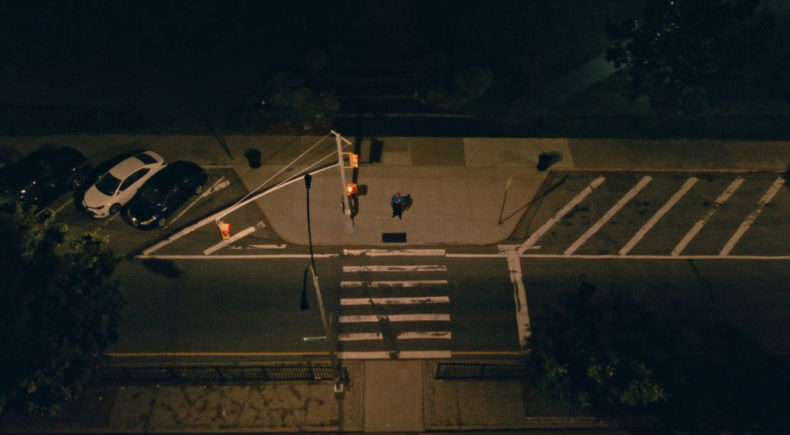
Slow, meditative, each shot in WEEKNIGHTS lingers until the depicted moment or architecture loses their familiar meanings and then gets recontextualized by the hungry night. Frequent, just barely off-kilter shots of empty college buildings shift in perception. You begin to question, “Is it off-center?” Then comes, “Am I off-center?” The night demands that people consider their own place within it, and WEEKNIGHTS conveys that experience masterfully. One particular shot hangs on a building for 30 seconds before our security guard steps into frame. When he does, it’s jarring.
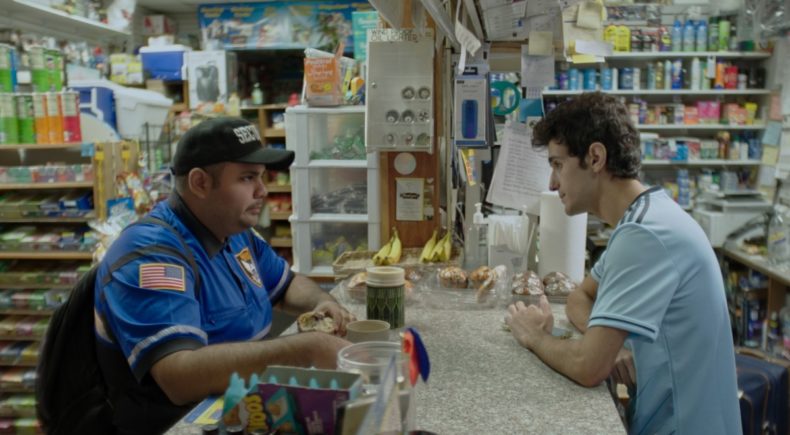
It recalls the impossibility of maintaining human connection with the other denizens of the night. At one point, we see our security guard stop into a bodega for a massive muffin and a lottery scratcher, and to refill his Thermos. He stalls, dragging out the interaction. First he buys the muffin and begins to eat it at the counter, then buys the scratcher, which he scratches at the counter. Then lastly, he asks the clerk if he needs additional payment for refilling the Thermos a second time. All the while, he tries to engage the disinterested clerk in small talk, mentioning a mutual acquaintance. When the clerk adequately demonstrates his disinterest in small talk, our security guard just stands there. At that time of night, just standing beside another person can remind you that you’re human.
I was taken by how shots in the film would mirror in interesting ways. Earlier in the evening, our camera perches at the top of a stairwell, looking down at our security guard standing at the top of the next flight of stairs. He stands quietly, watching a mouse scuttle back and forth on the top step. The mouse is a break from monotony. It crashes through an empty routine. Later, once Giancarli has fully made us comfortable as an omniscient observer, we see a wide shot of a quad with a park bench bathed in the stark and sterile light of a fluorescent street lamp. Eventually, our security guard walks into frame and sits on the bench. Unlike the moment where he felt shocking, obscuring our off-kilter view of an imposing building, here he’s small. He is inconsequential. He is the mouse, existing only to lend visual variety to our view of the night. He breaks up our routine.
It’s not just the park bench and similar shots that make our security guard feel small. Giancarli’s film communicates the soundscape of emptiness. The rhythmic pulse of traffic from a distant freeway loses form and sounds less mechanized and more organic. The night is a womb, and the sound of distant traffic is the beating of our own heart. The insistent buzz of fluorescent light makes the mind search for a bug that will never be there. There is no bug. We are alone.
As I sat down to write about WEEKNIGHTS, I saw multiple people comment that they thought the film was overlong, or would have been better as a short. I strongly, strongly disagree. Giancarli’s slow cinema approach replicates the sensation of how time dilates when we are alone. Back at the copy shop all those years ago, I remember finishing up orders that would be due the following morning, then appropriating time for myself to poke at a book I was writing and then look up at a clock and say, “Oh god, it’s not even 3am yet.” When it is just you and the night, the night is endless. I think of H.P. Lovecraft’s unnamed protagonist in The Outsider, shimmying up the tower he knows to be above the treeline and panicking as he realizes there is no sun. That’s the sense WEEKNIGHTS conveys. To “tighten” up these shots or grant us reprieve from monotony would mute the sense of dilated time.
The film is structurally and thematically most similar to Tsai Ming-liang’s GOODBYE, DRAGON INN and KEFF’s TAIPEI SUICIDE STORY. Both of those center their explorations of the liminal night on the worker, but each have their own unique reprieve. GOODBYE, DRAGON INN offers the romance and escape of cinema and the hopefulness of a well-worn, empty space being loved. TAIPEI SUICIDE STORY offers a brief and intense human connection, which stands in stark comparison to our security guard’s brief moment at the bodega. Both of those films offer reprieve in some way. WEEKNIGHTS grinds us. There is no romantic connection to the space. There is no brief and beautiful connection. It is empty hallways. It is ugly lights. It is the empty surface of the world, like the palm of a disinterested god, and the ugly buildings their fingers ready to crush our nameless protagonist in a fist. Not from any animus, but simply because the universe doesn’t know he exists.
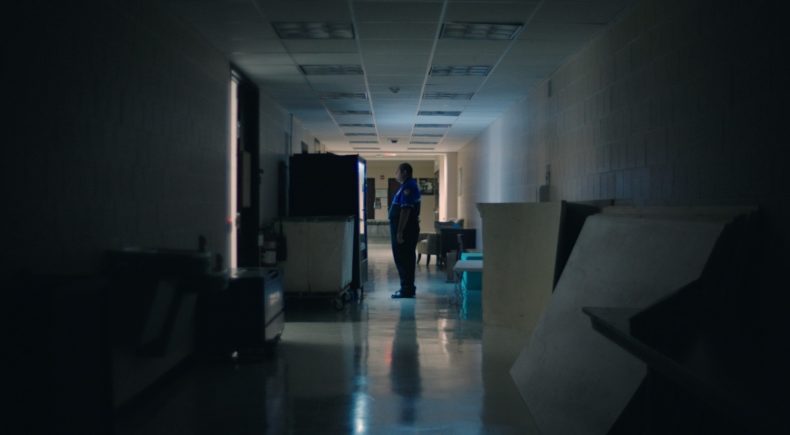
I keep coming back to how WEEKNIGHTS captures the endless quality of night and how repetition only amplifies that. Whether strolling a route as a security guard or changing a tray on a copy machine, these actions melt into one another. I’m changing a paper tray. It’s Monday. I’m changing a paper tray. It’s Thursday. I’m changing a paper tray. It’s last week. It’s next month. Planning feels impossible in the night. There is only the night. Our security guard feels carried along in the eddys and currents of the night. As the night unfolds, we never see him anchoring himself to anything outside the night, aside from a mysterious moment where we see him watch a video on his phone.
As the film wraps up, dawn breaks and natural light looks swollen, intrusive. Once acclimated to the night, the day frequently feels like too much. All the nooks and crannies of the places we spend the night are exposed. It demands a reflection on the world and self, which is often uncomfortable. Our security guard makes his way home, strips down his night clothes while a massive crucifix dominates the frame. The furniture doesn’t look like that of a young man, making the viewer wonder who he shares the space with. Who is up and out when he is sleeping? A parent he never sees? A grandparent? The film closes on him in bed, and situated on his nightstand are three coffee cups. I wondered if they had been filled with coffee to wake him at night, booze to lull him to sleep in the day, or a mix. When you work nights, that’s all you do, and that little visual note, along with our bodega scene and watching the mouse, are the moments where Giancarli dwells in the cost of the night.
WEEKNIGHTS is extraordinary. It captured those nights with the hum of machines and only my mind to keep me company. It captures what it feels like to think that every night, the night gives birth to me at dawn. To work nights is to be a ghost in an alien world, and this is the best representation of that experience I’ve ever seen.
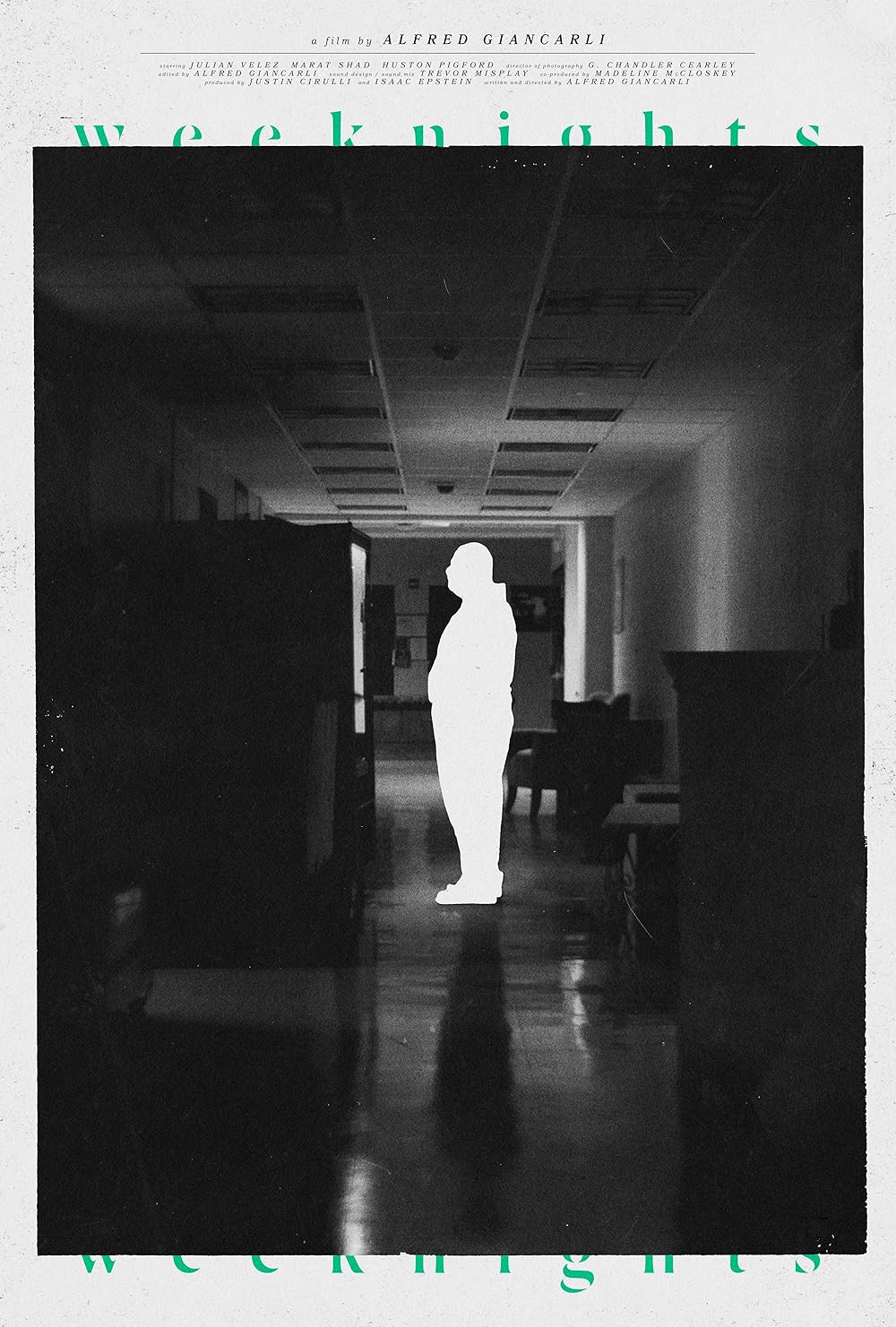
WEEKNIGHTS will be screening at 7PM on February 27th at Film Noir Cinema in Greenpoint, NY with a Q&A with director Alfred Giancarli after the film hosted by Brandon Streussnig.

them, not even once. When he’s not disappointing his cats he’s watching and writing about film.
His interests run toward naturalism, SOV and forgotten thrillers. Against his better judgment he
has hosted a podcast, Impossible Coin, for six years.
Tags: Alfred Giancarli, Film Noir Cinema, Film Screenings, Huston Pigford, Julian Velez, Marat Shad, New York City, United States
No Comments